
What is the National Pension System (NPS)?
The National Pension System (NPS) is a government-backed retirement savings scheme regulated by the Pension Fund Regulatory and Development Authority (PFRDA). It allows individuals to invest regularly during their working years and receive a pension (annuity) after retirement. The money invested in NPS is managed by professional pension fund managers, and the returns are market-linked, making it one of the most efficient and transparent retirement planning tools.
NPS is open to:
All Indian citizens (Resident/Non-Resident) aged 18 to 70 years
Employees from government, corporate, and private sectors
Self-employed professionals and business owners
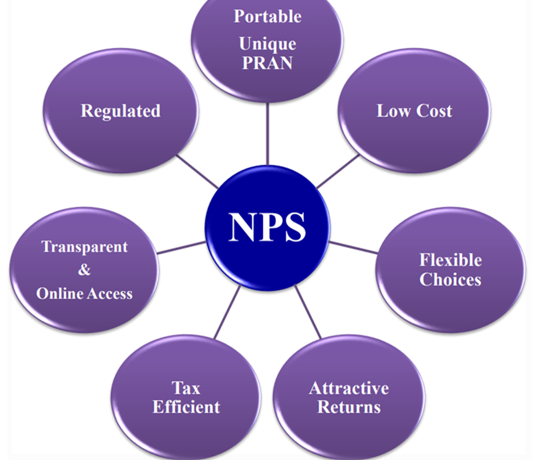
NPS is one of the best retirement planning tools offering a blend of security + market-linked growth + tax savings. With low costs, flexibility, and lifelong pension benefits, it is ideal for individuals who want a secured and stress-free retirement.
Page 2: Types of NPS Accounts, Investment Options & Tax Benefits
- Types of NPS Accounts
Feature | Tier I Account (Mandatory) | Tier II Account (Optional) |
Purpose | Retirement Savings | Voluntary Savings (like mutual funds) |
Withdrawal | Restricted till age 60 | Can withdraw anytime |
Minimum Contribution | ₹500 at opening | ₹1,000 to open |
Tax Benefits | Yes | No (except for Govt. employees) |
Lock-in Period | Till age 60 | No lock-in |
- Types of NPS Investment Choices
- Active Choice (You Decide Allocation)
You choose how your money is invested in:
- E – Equity (Max 75%)
- C – Corporate Bonds
- G – Government Securities
- A – Alternative Assets (Max 5%)
- Auto Choice (Life-Cycle Based Allocation)
Suitable for those who don’t want to manage investments. Allocation changes with age:
- Aggressive (LC75) – Higher equity till age 35
- Moderate (LC50) – Balanced equity & debt
- Conservative (LC25) – Lower equity, higher debt